I do not usually begin an article from a blank editor.
Usually, there is first a thought.
Sometimes it is a sentence that appears late at night. Sometimes it is a feeling left by work, reading, or daily life. Some things cannot be said clearly at first. They are only a few fragments, a few lines, or even just a direction.
Then I talk with AI.
Not to ask it to write an article for me directly.
It is closer to asking it to host a conversation.
It follows what I say and keeps asking: what was I really thinking then? Which parts are only emotion, and which parts contain a judgment? Is there a specific image, an experience, or a feeling that is difficult to explain?
I speak in sections.
Sometimes I say a lot.
Sometimes I only leave one sentence.
It is fine for those things to be mixed together.
At the beginning, format is not the important part. The important part is getting the thing out.
AI Is a Host, Not a Substitute
AI can help me organize, polish, check formatting, and translate Chinese into English.
It is a little like a part-time editor.
But it cannot replace experience or judgment.
What truly belongs to me in an article is not only the sentences that read smoothly, and not the expressions AI helps refine later.
It is what I experienced, why the thought appeared, and what judgment I am willing to leave behind.
AI can turn fragments into an article.
But the fragments have to be mine.
It can ask questions and help collect words that have drifted apart.
But it cannot feel for me, and it cannot decide for me whether something matters.
So I prefer to keep it in an appropriate place.
Not a ghostwriter.
Not a magical tool.
Only someone that can help me finish saying what I mean.
Make the Chinese Clear First
ByteForge Studio writes in Chinese first.
Because many thoughts first appear in Chinese.
Some feelings, memories, and irregular sentences easily become like instructions when English is considered too early. The pauses, roundabout phrasing, and casual judgments in Chinese are often closer to the original self.
So Chinese always comes first in this flow.
First, find the title.
Then write the introduction.
Then slowly speak the body out.
When the body is complete, check whether it is still what I originally wanted to say.
Not whether it is beautiful enough.
But whether it has been organized into something that no longer sounds like me.
Leave Formatting to the Tools
I do not want to spend too much time on formatting.
How the title is written, where the introduction goes, whether the cover path is correct, whether a tag is missing, whether an English version exists, and whether the build works: these should all have a stable process.
I only need to express.
AI helps organize the article structure, complete metadata, check formatting, generate the English version, and run a build check.
A cover image does not need to carry too much meaning either.
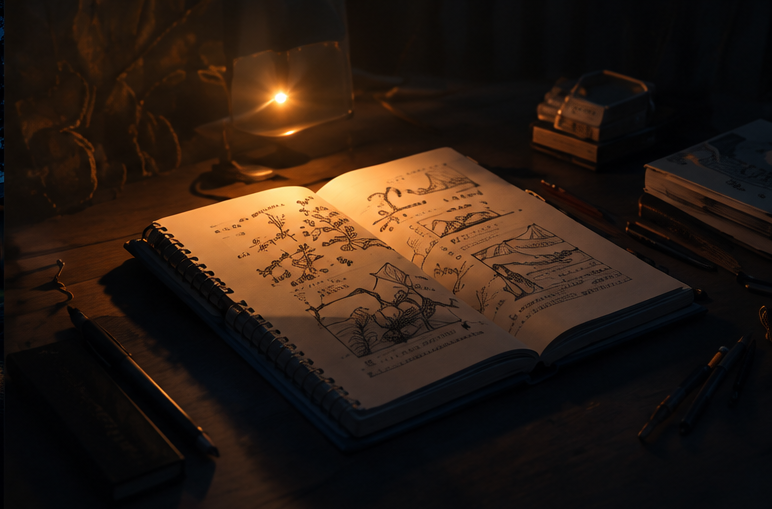
It mainly helps an article look comfortable and complete. It gives the words an entrance, and keeps the homepage from becoming only a field of titles.
At minimum, an article needs these things:
- A title
- An introduction
- A cover
- A body
- A content check
After the Chinese version is confirmed, the English version is made.
CMS Is Not the Main Writing Place
Decap CMS is still useful.
It is good for small changes, filling in metadata, or temporarily adjusting the state of an article.
But I do not want it to become the main place where I write.
Writing in a webpage still feels a little troublesome to me.
There is an interface, waiting, synchronization, and sometimes a feeling that the article has already been placed inside a system instead of still growing slowly.
Local Markdown is quieter.
The files are here.
An article is what it is when it is written.
Afterward, GitHub keeps a version record, and the build turns it into a website.
This does not mean CMS is bad.
It only means that for ByteForge Studio, it is better for maintenance than for the place where thinking happens.
A Push Means the First Review Is Complete
A GitHub push is not only a backup.
It is more like the first review being complete.
When an article has a title, introduction, cover, Chinese body, and English version, when its format has been checked and the site builds without problems, it can be pushed.
That does not mean it can never change again.
Articles can of course be revised later.
But at the moment of pushing, it is already a complete version.
It can be published on a chosen day.
Or it can stay there quietly for a while.
I like that feeling.
Not throwing something out immediately after writing a paragraph.
But organizing it first, placing it where it belongs, and then checking that it can stand.
A Lighter Way of Writing
This flow will not suit everyone.
Some people are good at finishing an article in one sitting inside an editor.
Some people prefer to publish directly from a CMS.
Some need more complicated collaboration and review.
But if someone only wants to keep writing for a long time, without being worn down by formatting, platforms, and process, this lighter method may be worth trying.
Think first.
Then speak.
Let AI ask and organize.
Keep experience and judgment for yourself.
Finish the Chinese version, then translate it into English.
Check it, then push it.
Finally, an article stays here.
It may not be perfect.
But at least it has a path behind it.